Garage Doors
How doors work
Every month we hear the same handful of worries from different households. This section answers them once, clearly, so you can read at your own pace and call when you are ready.
Ask us anything
How long does the visit usually take?
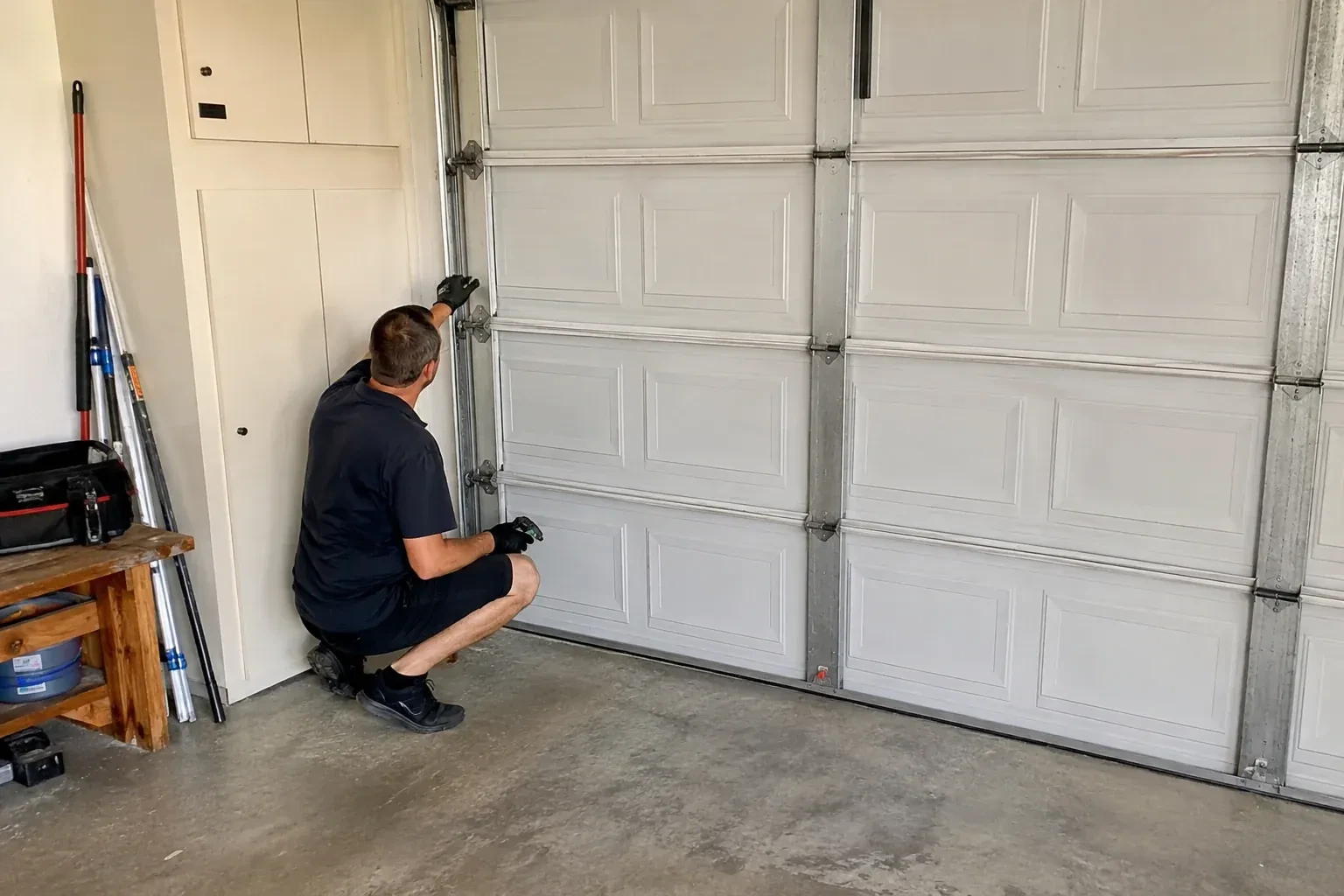
Plan for roughly an hour for a single door in ordinary condition, and longer for a double door, a second door on the property, or a door with a history that needs following up. Maintenance done on the spot adds a few minutes. A post-impact assessment, where the technician traces the force through the hardware, takes longer than a routine check. You are told at the door if the scope is growing.
Can a tune-up make my noisy door quieter?
Usually, yes, and often dramatically. Most garage door noise comes from dry hinge pins, dry roller bearings and hardware that vibration has loosened, and those three are exactly what a tune-up addresses. Some noise comes from parts that have worn, such as a roller gone out of round or a chain that has stretched, and the technician tells you which sounds were settled by maintenance and which point to a part worth replacing, with a separate quote for that.
How often should the door be checked after this?
A monthly look of your own at rollers, cables, hinges and the reversal test keeps small problems small, and a professional tune-up once a year covers the parts you cannot safely handle: spring tension, cable condition, track alignment and opener settings. A door that has come off its track once is worth this attention, because the event often reveals wear that has been building for a while.
Is a panel the same thing as a section?
In everyday speech, yes: people call the horizontal pieces of a garage door panels. In the trade's own terminology a section is the full-width piece that hinges to its neighbours, and a panel is one of the raised or recessed shapes embossed across it, so a door might have four sections of four panels each. When you ask for panel replacement, the technician understands you mean the section, and will confirm which one.
My garage floor is uneven. What are the options?
Three, and they can be combined. A taller bulb-style seal compresses more and follows a modest dip or crown. A threshold seal fixed to the floor follows the slab's existing contour and gives the door a raised, consistent line to land on where it is dished or sloped. And where the floor has heaved or broken up badly, grinding or patching the concrete is a separate job that makes any seal perform better. The gap map from the first look shows which applies.
Will replacing the perimeter seal keep mice out?
It closes one of their favourite routes. Mice enter at the open corners where the header and side seals meet and along a fin that has shrunk back from the door, so a continuous, overlapped seal removes those gaps. It works alongside a sound bottom seal, a swept threshold and attention to any other openings in the garage wall, and a technician will point out any of those noticed during the visit.
Can the garage handle be keyed to my house key?
Often, yes. The cylinder in a T-handle is a small pin-tumbler lock, and if it shares a keyway with your house locks it can be pinned to the same combination. Where the keyways differ, a compatible cylinder can usually be fitted to the handle so the match is possible. Bring a house key to the visit and the technician will tell you on the spot.
Can I replace just the one roller that looks bad?
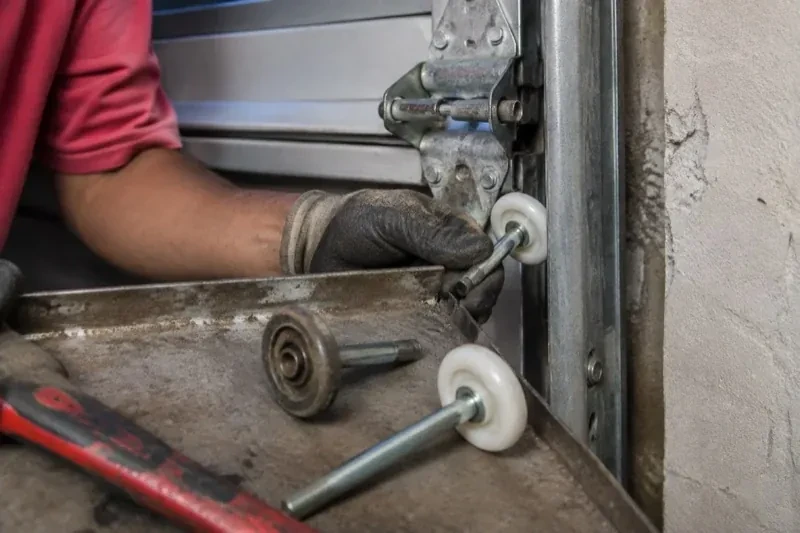
One roller can be changed on its own, and sometimes that is the sensible stopgap after a wheel breaks. The better result comes from a full set, because the other wheels have done the same number of cycles and are close behind, and mixing new with old, or nylon with steel, leaves the door running unevenly and sounding different on each side. A matched set also lets the technician set every top fixture and check every hinge in one pass.
What information helps when I book the visit?
Whether the door is closed, open or stuck; where the noise or the gap appears and roughly how high; whether you can see a cracked, bent or loose hinge and whether it is at the edge or the middle; whether the door is a single or a double, steel or wood, and how many panels it has; and whether anything hit the door lately. A photo of the hinge and its stamped number is useful.
Can a low-headroom or high-lift layout be fitted to my existing door?
Often, yes, and it is a track job with a spring job attached. Low-headroom dual track lets a door open under a low ceiling or a beam, while high-lift track carries the door further up the wall to clear a car lift or storage. Each changes the horizontal run, the curve, the top fixtures and usually the cable drums and spring turns. The technician measures headroom, sideroom and backroom first and confirms the door suits the change.
Why should the bottom brackets never be loosened by hand?
The bottom bracket is where the cable attaches, so whenever the springs are wound it carries a share of the door's weight as tension. Loosening it while the counterbalance is loaded releases that tension all at once. Many manufacturers now fit tamper-resistant fasteners for this reason. The technician unloads the springs first, after which the bracket is just a piece of hardware to unbolt and replace.
Will the new spring look the same as the old one?
Not necessarily, and that is fine. The paint colour on the winding cone or coil is a code that identifies wire size and wind direction, and different suppliers use their own schemes, so a matched replacement can carry a different colour than the spring it replaces. What matters is that the wire size, diameter, length and wind direction suit the door's weight and height, which is confirmed by the balance test.
Is it all right to keep shelves and storage near the springs?
Keep a clear zone around them. The springs, pulleys and cables move on every cycle, and anything leaning into their path, such as a ladder, a hockey bag or a shelf edge, can catch a cable or knock a pulley. Storage that crowds the rear hangers also slows any future service. A hand's width of clear air around each spring's full travel, and nothing hung from the springs or their cables, is the rule of thumb.
Can a door with a broken spring be balanced?
A broken spring is replaced rather than adjusted; there is nothing left to wind. On a two-spring door the technician normally replaces both, since the survivor has the same age and cycle count, and then balances the door on the new pair. Until the visit, leave the door closed and avoid running the opener, which is not designed to lift the door's full weight on its own.
My remote only works when I am close to the door. Why?
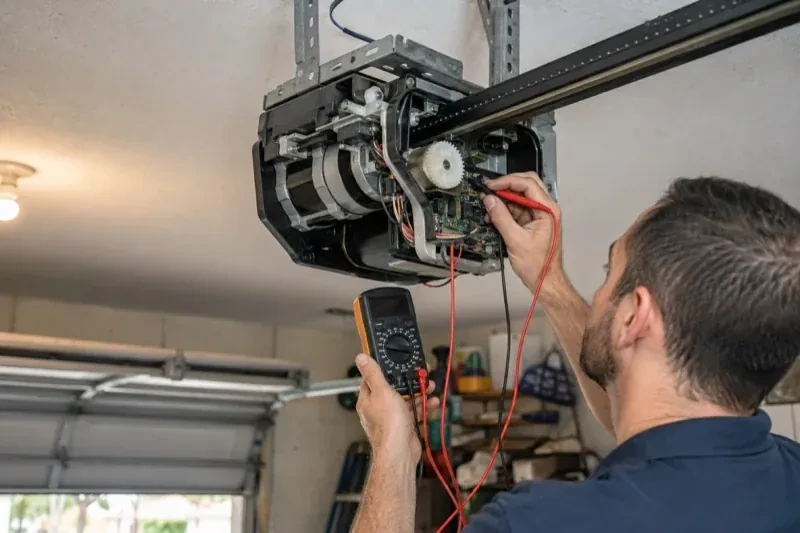
Short range is almost always interference or a weak signal, not a broken opener. Certain LED bulbs, including ones fitted in the opener's own sockets, emit noise on the frequency remotes use. A remote battery near the end of its life also loses reach before it fails outright. The technician tests range with a known-good remote, swaps bulbs, checks the antenna wire hangs free below the head unit, and replaces the battery or remote as needed.
How much slack should the chain have?
It is a measurement, taken with the door closed and disconnected from the trolley. At the middle of the rail the chain should sit at the height the opener's own manual specifies for its rail shape, since the figure is not the same across makes. The two nuts on the trolley set and lock it. With the door reconnected and closed, some droop appears; that is expected as long as the measurement returns when the door is open.
Can a belt from any opener be used, or does it have to match?
It has to match. Belts are made in lengths for particular rails, so a 7 ft door rail and an 8 ft rail take different belts, and the teeth must match the sprocket's pitch. The clip or link that joins the belt to the trolley also differs between makers. The technician reads the model from the head unit's label and brings the belt made for it.
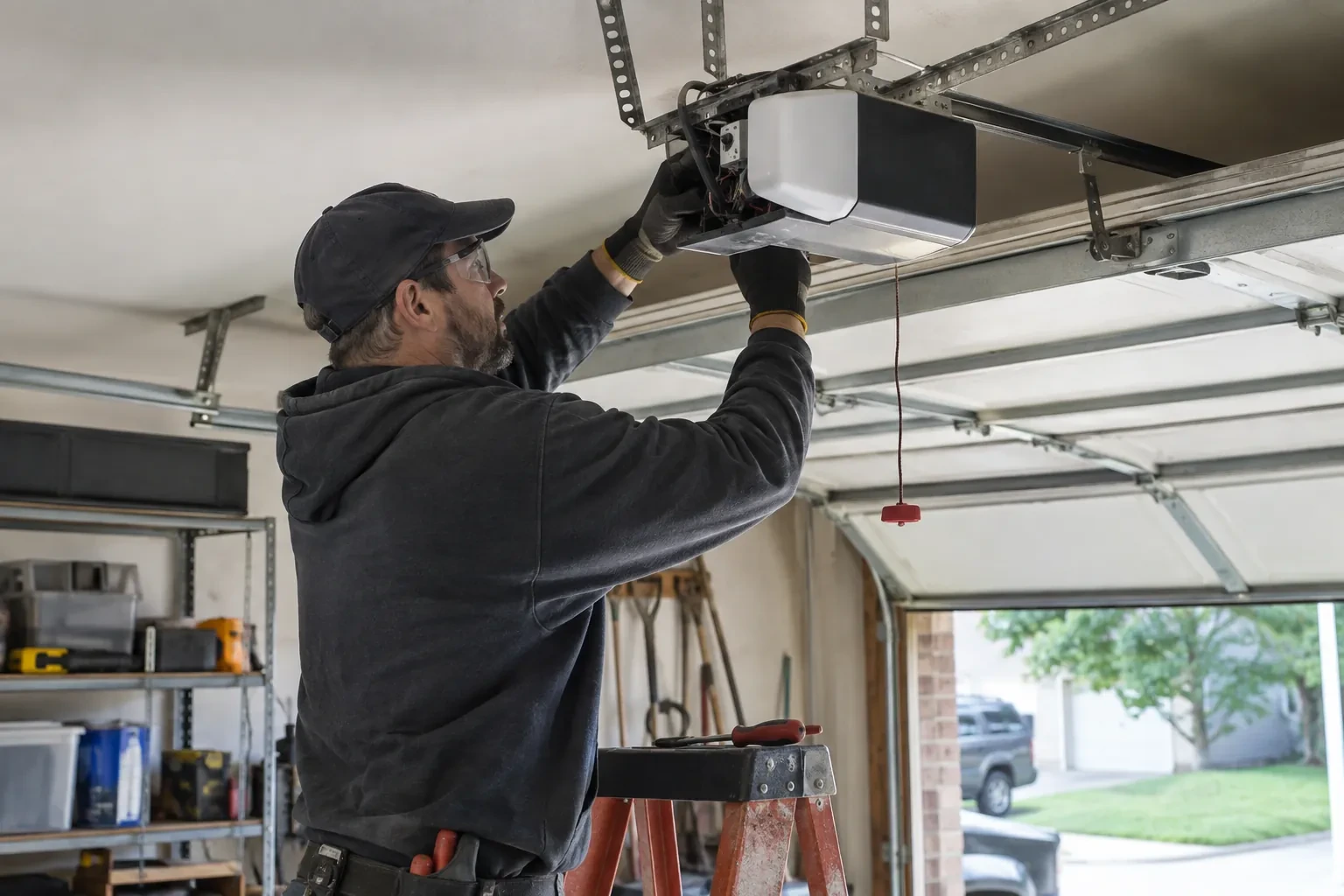
What is the red cord for?
It is the manual release. A tug on the red handle unhooks the trolley from the door arm so the door can be raised and lowered by hand while the power is off or the operator is being serviced. It hangs high enough to clear a vehicle roof but low enough to reach without a ladder. To reconnect, most units need only be run once and the trolley picks the arm back up; a few take a second tug.
Do sensors wear out with age?
They do, slowly. The infrared emitter and the receiver dim over many years, lenses craze or cloud from sun and salt, housings crack, and water finds its way in at floor level. A pair that needs re-aligning more and more often, or whose light drifts between steady and flickering with nothing touched, is usually ageing. Because pairs are matched to the opener, an older opener is worth identifying early so the right replacement is on hand.
How do I program the built-in button in my car?
Often in two steps, on a common HomeLink-style setup. First the car learns a working handheld remote: hold the remote close to the mirror or console and press its button together with the vehicle button until the indicator changes. Then the opener learns the car: press learn on the head unit, walk back to the car within the window that follows, and press the trained button repeatedly until the door responds. Some vehicle systems use a different sequence with no handheld remote, so the vehicle manual is checked first.
Can other people in my household use it?
Yes. The owner's account invites each family member as a user with their own login on their own phone. Each person's opens and closes appear in the history under their name, and the owner can adjust or remove any user at any time. Sharing one login is discouraged because it muddles the history and makes it harder to remove access for one person later.
Where should I grip the door when lifting it by hand?
Use the door's own handles or the gripping points built into the panel face, on the inside and outside of the door. Sectional doors are meant to have them near the bottom section and again on the second or third section. Never take hold at the joint between two sections, which closes as the door bends around the track. If your door has no handles or they have been removed, the technician can fit a pair during the visit.
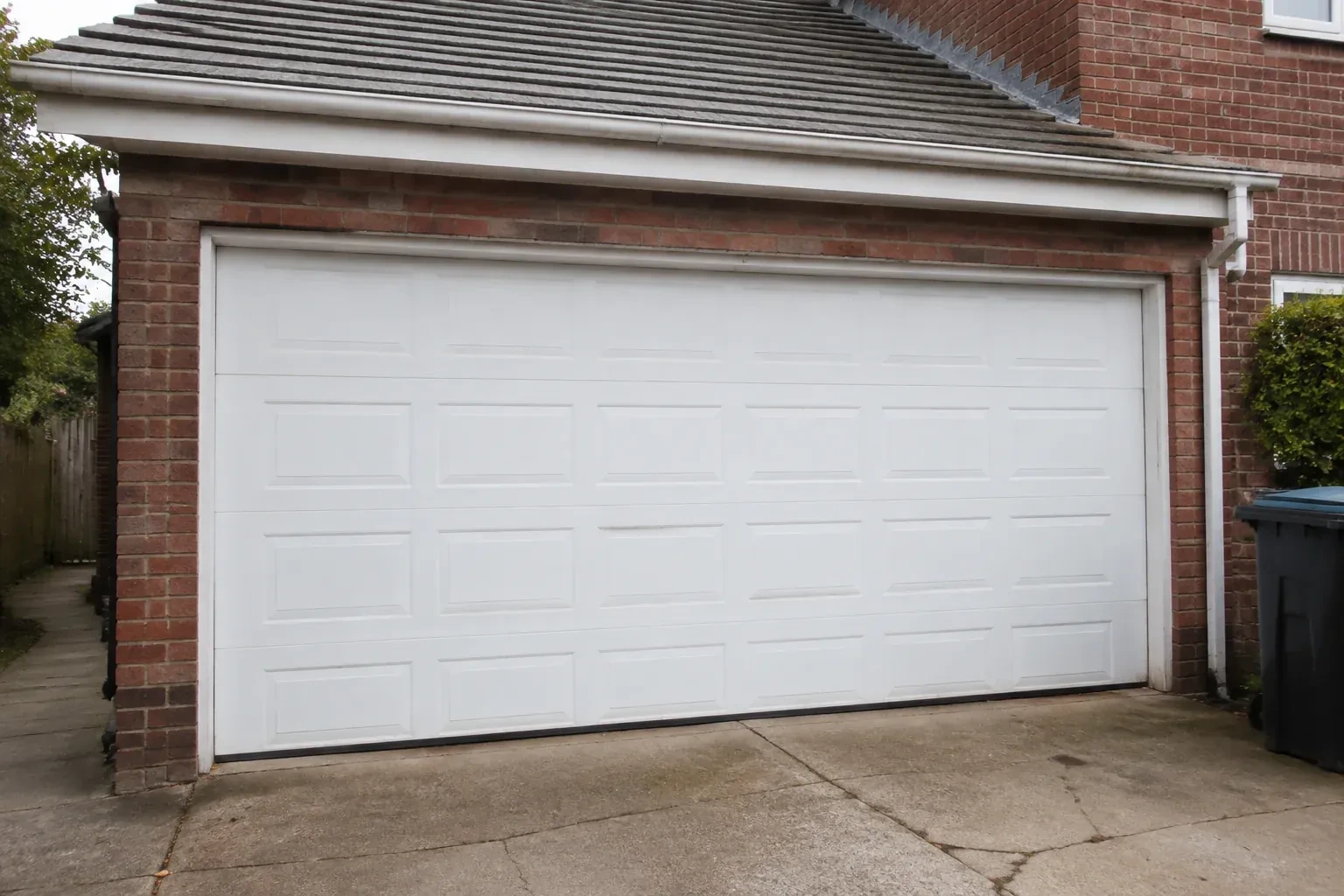
How is the old door removed?
Technicians disconnect the operator, stabilize the assembly and control the spring system before detaching cables or high-tension fixtures. Sections are supported and separated in sequence, followed by track and related hardware. The agreed scope states whether removed materials are taken away, while site protection keeps nearby finishes and belongings clear during dismantling.
Does an uneven garage floor affect the result?
Yes, because the bottom seal meets the slab across the entire width. Measurements show whether the floor slopes consistently, has isolated high spots or has settled at one corner. A flexible astragal can accommodate modest variation, while larger differences may need a separate floor or threshold solution. Door limits should be set to close evenly rather than compress one side excessively.
Do the tracks form part of the wind-rated system?
Yes. Tracks guide the rollers during daily travel and help retain the closed door when pressure acts across it. Gauge, shape, brackets, roller stems, fasteners, and attachment spacing may differ from a standard installation. That is why a wind-rated replacement is planned as a coordinated assembly instead of pairing reinforced sections with whichever tracks happen to be present.
Can a carriage-house door work with low headroom?
It often can, provided the available space is measured and a suitable track and spring arrangement exists for the selected door. Low-headroom layouts change how the top section turns and where hardware sits above the opening. Ceiling obstructions and opener geometry must be considered at the same time, so this condition belongs in the survey before the door configuration is ordered.
Will a glass garage door keep out winter drafts?
Insulated glazing, section seals, perimeter stop mould and an even bottom seal can improve enclosure performance when they are selected and fitted together. Draft control also depends on jamb condition, floor shape and the rest of the garage envelope. The assessment matches the construction to how the room is used and checks seal contact after the door is aligned.
How can the installed door be protected during remaining construction?
Keep masonry, paint, plaster, floor coatings and abrasive dust away from sections, seals, tracks and rollers. Other trades should avoid leaning materials against the door or using horizontal tracks for storage or support. Controls can be managed so the system is operated only by authorized project personnel before handover. If protective covering is used, it should avoid trapping moisture or adhesive against the finished surface.
Does a torn bottom seal always mean a seal-only repair?
Not always. The rubber may simply be worn, but a bent retainer, uneven floor, crooked door or impact-damaged bottom section can produce the same gap. The technician checks how the door lands before replacing material. Correcting level or retainer shape first allows the new seal to contact evenly without being stretched to compensate for another fault.
What happens to a powered door during a power interruption?
Commercial operators commonly include a manual hoist, hand chain or disconnect arrangement, but the sequence varies by system. Staff are shown the intended changeover and normal manual effort after repair. The door must still move freely and remain balanced; the emergency method is an operating feature, not a substitute for correcting a binding curtain or worn component.
How should I care for the converted tracks?
Keep the track path clear and visually check that brackets remain secure, rollers stay centred and cables wind neatly. Clean debris from accessible areas, but avoid applying grease inside the track unless the door instructions specifically call for it. Lubricate only the points and products identified for the installed system. Loaded spring, cable and bracket adjustments belong in a technician's service scope.